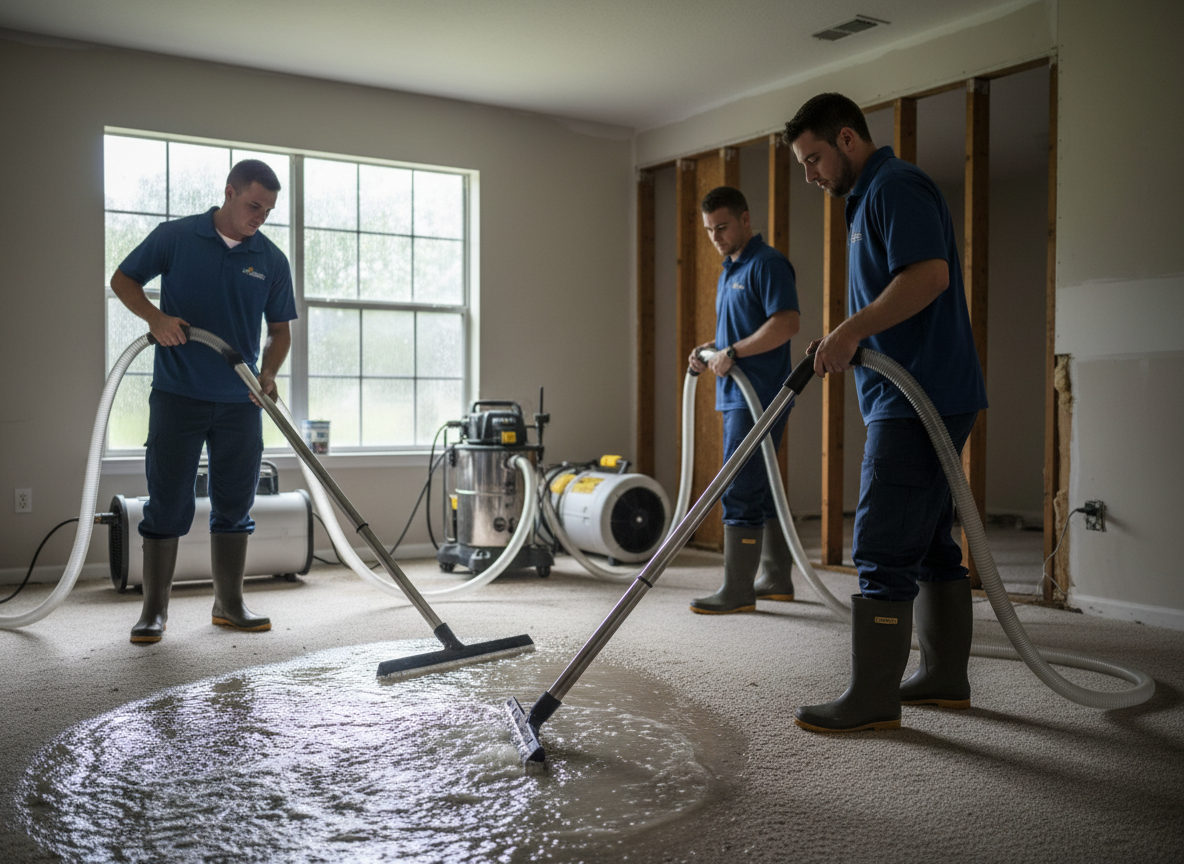
How quickly should standing water be removed from a Melbourne home? Standing water should be extracted as soon as possible after a leak, flood, or appliance failure. The Florida Department of Health advises that common molds can take hold when water stands for even 24 hours, and Brevard County humidity frequently runs between 70 and 80 percent year-round. In Melbourne, where summer afternoons push humidity above 90 percent, wet carpet, drywall, and framing do not dry out through ventilation alone. Water extraction in Melbourne removes the bulk water immediately, which slows the progression of damage and shortens the overall drying timeline. Waiting even a day can turn a simple water removal job into a mold remediation project.
Why choose Water Leak Detection Melbourne for water extraction? Some carpet cleaning companies offer water removal with a shop vac and a few fans, but that is not water extraction. Water extraction in Melbourne uses truck-mounted or portable extraction units that remove hundreds of gallons of standing water fast, plus submersible pumps for deep flooding. Water Leak Detection Melbourne pairs extraction with moisture mapping so technicians know exactly where water has traveled under flooring and behind baseboards. Unlike general handymen who dry the surface and call it done, our approach targets hidden moisture in subfloors and wall cavities. You get a crew that understands Brevard County construction and the local humidity that keeps materials damp long after the visible water is gone.
Why is water extraction urgent during Melbourne's rainy season? Melbourne's wettest months run roughly June through September, with monthly rainfall often exceeding six inches, and tropical systems can deliver extreme totals in a short time. Tropical Storm Fay in August 2008 produced a maximum rainfall of 27.65 inches eight miles northwest of Melbourne, per the National Weather Service Melbourne office, overwhelming drainage and flooding homes across Brevard County. During storm season, roof leaks, window intrusion, and rising groundwater push water into living spaces quickly. Fast water extraction in Melbourne limits how far water wicks up drywall and how much framing absorbs, which reduces both repair cost and the chance that mold colonizes the structure while the home is still damp.
What facts support professional water extraction in Brevard County? Brevard County building permits are required for repair or replacement of interior and exterior walls, and interior demolition requires a separate permit. The county Building Department at 2725 Judge Fran Jamieson Way in Viera issues permits and schedules inspections, typically within 24 to 48 hours of request during normal operations and under expedited procedures after a declared emergency. The City of Melbourne flood hazard information page notes that Brevard County participates in the National Flood Insurance Program and maintains flood hazard mapping. Tropical Storm Fay remains a benchmark local flood event, with the NWS Melbourne office recording 27.65 inches of rain eight miles northwest of Melbourne. These are public records from county and federal sources.
What if flooding hits a finished basement or crawl space in Palm Bay? Many Palm Bay homes have finished lower levels or crawl spaces that sit close to the water table. When heavy rain overwhelms drainage or a pipe bursts upstairs, water gravitates to the lowest point and pools in these areas. A common mistake is running a household fan and waiting for the water to evaporate. Because crawl spaces have limited airflow and finished basements trap moisture behind wall coverings, standing water there can persist for days. Water extraction in Melbourne includes submersible pump removal of pooled water followed by targeted extraction from carpet and padding. Technicians then place air movers and dehumidifiers sized to the space so hidden moisture in framing and subfloor is addressed. This scenario is frequently overlooked by companies that only treat visible surface water.
What equipment is used for professional water extraction? Professional water extraction uses truck-mounted or portable extraction units with high vacuum power to remove standing water from carpet, hard floors, and subfloors. Submersible pumps handle deep flooding in basements and crawl spaces. After bulk removal, weighted extraction tools pull moisture from carpet and padding. Moisture meters and thermal imaging cameras then locate water that has wicked into drywall, baseboards, and subflooring where it is not visible. Air movers and low-grain refrigerant dehumidifiers complete the drying process by removing moisture from the air and materials. Carpet and padding trap large amounts of water and dry slowly because airflow cannot reach the underside, so mechanical drying is essential.
What should I ask before scheduling water extraction? Ask how fast extraction can begin, whether the crew extracts water from carpet and padding, and whether hidden water behind walls will be checked. Water Leak Detection Melbourne prioritizes emergency water extraction calls so bulk water removal starts as quickly as crew and equipment allow. We serve Melbourne, West Melbourne, Palm Bay, Indialantic, Melbourne Beach, Indian Harbour Beach, and Satellite Beach. Moisture meters and thermal imaging locate water that has wicked into drywall, baseboards, and subflooring so it is not missed.
Why is a household mop or shop vac not water extraction?
A mop and a household vacuum remove the water you can see on the surface. They do not pull water out of carpet pad, subfloor edges, or the base of a wall where it has already wicked up. Professional extraction uses a high-vacuum extractor on floors and a weighted tool on carpet so water is lifted from the pad, not just the face yarn. After the bulk water is gone, the room still needs airflow and dehumidification, because Melbourne air at an average 75 percent relative humidity, per 1992 to 2021 airport climate averages, will not finish the job. Extraction is the first step. It is not the whole dry-out.
When does a submersible pump belong in the extraction plan?
Pooled water in a low room, garage, or crawl space is too deep for a floor tool alone. A submersible pump moves that standing water out so the extractor can work the surfaces that remain wet. The pump does not map where water traveled under flooring. That still takes a moisture meter and, where the path is hidden, a thermal camera. In Brevard County, heavy tropical rain has already shown how fast low areas fill. The National Weather Service Melbourne office recorded 21.42 inches at a gauge 1.4 miles west of Palm Shores and 22.87 inches two miles north of Satellite Beach during Tropical Storm Fay in August 2008, on top of the 27.65-inch maximum eight miles northwest of Melbourne. Low spots do not drain on a household schedule.
Which materials hold extracted water the longest?
Carpet pad can stay saturated after the carpet face looks damp rather than flooded. Drywall wicks water up from the base and holds it in the paper face. Untreated wood framing and particle board at cabinet bases absorb water at the edges and release it slowly. Concrete block holds water in cores and mortar joints after the painted face feels dry. Those four materials are why an extraction visit includes a moisture map, not only a pump-out. If any of them stay wet past the 24-hour mark the Florida Department of Health cites for mold taking hold, removal of the porous piece may be required, and wall replacement in Brevard County needs a permit.
What do air movers do after the standing water is gone?
Air movers push air across wet surfaces so moisture can leave the material and enter the room air. They do not remove that moisture from the house by themselves. A dehumidifier has to collect it, especially when outdoor humidity is already high. Brevard County summer normals for 1996 to 2025 show roughly 6 to 8 inches of rain in each of June, July, August, and September, so storm season is not a time to rely on open windows. Movers are aimed along floors and into wall cavities that have been opened, not parked in the middle of a dry hallway. Placement follows the moisture map, and readings decide when the movers come out.
Do you need a Brevard permit just to extract water and dry in place?
Drying in place, with no wall removed, is not the work the county lists as requiring a building permit. Repair or replacement of interior or exterior walls does require one, and interior demolition as part of restoration needs a separate permit. After a declared emergency, Florida Statute 553.7922 is the basis for Brevard's expedited process for permits that do not need technical review, with the county expecting those permits in about three business days. The post-storm center address in the county guide is 2725 Judge Fran Jamieson Way, Building A, Room 114, Viera, FL 32940, and the call line is (321) 633-2187. Extraction can start without waiting on a wall permit. Reconstruction cannot skip it.
What if Fay-type rain fills a low room and the pad stays wet after the puddle is gone?
Tropical Storm Fay, August 18 to 23, 2008, did not need hurricane winds to wreck finishes. The National Weather Service Melbourne office called the rainfall the standout impact and logged repeated bands while the storm crawled near the Brevard coast. Gauges around Melbourne, Satellite Beach, and Palm Shores all recorded more than 20 inches. In a low room, that kind of rain shows up as standing water first and as a soaked pad second. Companies that pump the visible water and set one fan in the doorway leave the pad and the wall base wet. Those are the materials mold uses. The Florida Department of Health says mold can take hold when water stands for even 24 hours and tells owners to keep indoor humidity below 60 percent.
Water extraction in that situation is a sequence. Pump the pool. Extract the carpet and pad with a weighted tool. Map the wall base and any block or framing the water touched. Then run air movers and a dehumidifier sized to the closed room, not to the outdoor breeze. If drywall has to come out, that is a Brevard permit item, separate from the extraction itself. Water Leak Detection Melbourne treats the hidden water as part of the same job as the puddle. Call (321) 732-4518 when a low room is still wet after the rain stops.
How should clean water, washer water, and floodwater be extracted differently?
Clean water from a supply line or rain that has not mixed with sewage is still destructive, but porous materials sometimes can be dried if extraction starts quickly. Washer, dishwasher, and toilet-overflow water carries more contamination, so pad and other porous finishes are weaker candidates to save. Floodwater and sewage are the strictest case: porous materials that soaked in them are removal items, not dry-in-place items, because the Florida Department of Health ties mold growth to moisture plus a food source such as wood, sheetrock, or dust. The category changes the extractor setup and what gets bagged, not the phone number you call. It does not change the 24-hour clock. Water that sits still feeds growth whether it started clean or not.
What should stay off while extraction is underway?
Do not walk through standing water if a breaker, a cord, or a gas appliance may be in it. Do not run a household fan into a room that still has an inch of water on the floor and an outlet at baseboard height. Do not carpet a bathroom that has flooded. The Florida Department of Health specifically advises against carpet in bathrooms because those rooms stay damp. If the storm damaged the roof, temporary tarping does not need a Brevard permit, but cutting out wet walls does. Extraction crews should be able to reach the wet rooms, the air handler closet, and the crawl access without moving debris onto a wet breaker panel. Those limits are safety and county rules, not a timeline promise.
Why compare Fay's gauge totals instead of treating every Melbourne flood as the same depth?
Fay's rain was not one number for every neighborhood. The National Weather Service Melbourne office recorded 27.65 inches eight miles northwest of Melbourne, 21.88 inches six miles northwest of Melbourne, 22.87 inches two miles north of Satellite Beach, and 21.42 inches 1.4 miles west of Palm Shores. A house on slightly higher fill can have wet carpet while a house nearer a ditch has water in the wall cavities. Extraction scope follows the rooms that metered wet, not the countywide rainfall headline. That is also why a neighbor's dry-out does not describe yours. Call (321) 732-4518 and describe which rooms held water and how long they stayed wet.