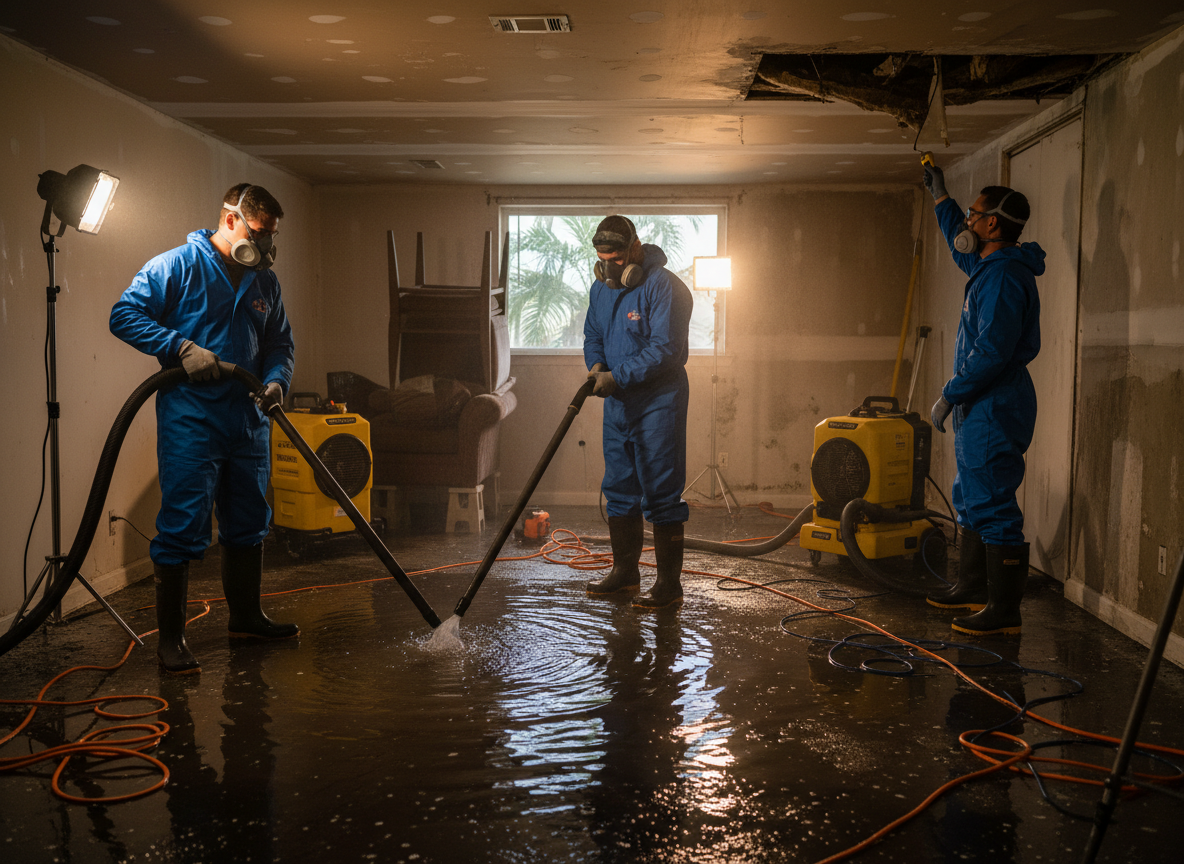
What does water remediation involve for a Melbourne home? Water remediation goes beyond water removal. It includes emergency extraction, structural drying, moisture mapping, cleaning and sanitizing affected areas, and verification that building materials have reached acceptable dryness. In Melbourne's humid climate, the air itself carries a high moisture load, so simply opening windows will not dry out a saturated wall. Water remediation in Melbourne uses industrial air movers and dehumidifiers to control the drying environment, plus moisture meters to confirm that drywall, subflooring, and framing are dry before repairs begin. The process ends only when the structure is confirmed dry, not when the visible water disappears.
Why choose Water Leak Detection Melbourne for water remediation? Many restoration outfits handle extraction but stop before verifying that the structure is actually dry. Water Leak Detection Melbourne follows the full remediation sequence: extract, dry, clean, and confirm. We document moisture readings throughout the process so you know the drying target was reached. Because we focus on Brevard County homes, we understand how local slab construction, concrete block walls, and coastal humidity affect drying times. Unlike companies that treat every job the same, we adapt the remediation plan to the water category, the materials affected, and the local conditions that influence evaporation.
Why is timely water remediation critical in Brevard County? Brevard County's climate accelerates the timeline on water damage. Average relative humidity runs between 70 and 80 percent year-round and rises above 90 percent during summer afternoons and storm events. When a home is wet, that ambient moisture slows evaporation and keeps materials damp longer. Tropical Storm Fay in August 2008 produced a maximum rainfall of 27.65 inches eight miles northwest of Melbourne, according to the National Weather Service Melbourne office, and caused widespread flash flooding across Brevard County. After such events, homes that are not remediated quickly develop mold and structural deterioration. Starting water remediation in Melbourne within the first 24 to 48 hours significantly reduces the scope of loss.
What verifiable facts support water remediation standards? The Florida Department of Health states that common molds can take hold when water stands for even 24 hours and recommends keeping indoor humidity below 60 percent to prevent mold growth. Brevard County requires building permits for the repair or replacement of interior and exterior walls, and interior demolition as part of restoration requires a separate permit. The Brevard County Building Department at 2725 Judge Fran Jamieson Way in Viera issues permits and schedules inspections. Under Florida Statute 553.7922, the county provides expedited permitting after a declared emergency, with qualifying permits expected to be processed within three business days. These are county and state public records.
What if water damages a concrete block wall behind a Melbourne kitchen? Concrete block walls are common in Melbourne and Brevard County construction, yet many remediation companies treat them like drywall and simply dry the surface. Water remediation in Melbourne must account for the fact that concrete block is porous and holds moisture in its cores and mortar joints. Surface meters may read dry while the block interior remains saturated. This is a scenario top competitors often miss: they dry the visible face, close the wall back up, and leave trapped moisture that later drives mold growth behind paint and baseboards. Proper remediation of a concrete block wall includes drilling for internal moisture readings, drying the block cavity, and confirming dryness before reconstruction. Water Leak Detection Melbourne addresses hidden moisture in block walls rather than assuming the surface tells the whole story.
What are the categories of water damage and which materials are most at risk? Water damage is classified by source and contamination level. Category 1 is clean water from a supply line, rain, or appliance. Category 2 is gray water with some contamination, such as dishwasher or washing machine discharge. Category 3 is black water, such as sewage or floodwater, which requires the most cautious handling and removal of porous materials. Drywall, insulation, carpet padding, particle board, and untreated framing absorb water readily and can lose structural strength. Concrete block holds moisture internally. Hardwood floors can cup and warp. Materials that remain wet beyond 24 to 48 hours are candidates for removal and replacement.
What should I ask before hiring a water remediation company? Ask whether the company verifies the structure is dry before repairs, how long remediation takes, and whether insurance documentation is provided. Water Leak Detection Melbourne takes moisture readings throughout drying and confirms materials meet dry standards before any reconstruction begins. Minor incidents often dry in three to five days; larger floods can take a week or more depending on materials and weather. We serve Melbourne, West Melbourne, Palm Bay, Indialantic, Melbourne Beach, Indian Harbour Beach, and Satellite Beach. Call (321) 732-4518 to discuss your water remediation needs.
How do dehumidifiers support a dry standard in Melbourne air?
A dehumidifier pulls water out of the room air so wet materials can keep releasing moisture. Air movers only speed that release. They do not store the water. The Florida Department of Health target is indoor humidity below 60 percent, and below 50 percent when the aim is stronger control of mold and dust mites. Melbourne's airport climate average for 1992 to 2021 is 75 percent relative humidity, so outdoor air is a poor drying engine for a closed, wet room. Daily readings, not a calendar guess, decide when the machines come out. A room that feels dry and still meters wet is not finished.
What does a daily moisture log actually record?
A remediation log records the material, the location, the meter reading, and the day. The same spots are checked again so a falling number is real, not a new spot chosen because it looks better. Drywall, wood, carpet pad, and concrete are logged separately because they dry at different speeds. The log is also the paperwork that shows a carrier or a property manager what was wet and when it reached a dry reading. It is not a price list and it is not a promise about an insurance payout. Policies differ. The readings are simply a record of the structure.
Why does a concrete block wall need a different drying check?
Concrete block is porous. Water can sit in the cores and in the mortar after the painted face no longer looks damp. A meter on the paint can read lower than the core. Remediation of a block wall in a Melbourne or barrier-island house includes readings at the base, at grout lines, and at any opened core, plus airflow into the cavity if the wall has to be opened. Closing the wall on a dry face and a wet core is how mold returns behind new paint. That is a local construction issue, not a generic basement script from another state.
Which materials usually come out, and which can stay?
Porous materials that stayed wet are the ones most often removed: wet insulation, carpet pad, swollen particle board, and drywall that has lost its face or stayed above a dry reading. Hard surfaces that can be cleaned and confirmed dry can often stay. The Florida Department of Health notes that wood, sheetrock, and even dust can feed mold once moisture is present, and that mold can take hold when water stands for 24 hours. The 24-hour mark is a reason to start, not a slogan. Category of water matters too. Clean supply water, gray water from a washer, and sewage or floodwater are not handled the same way, and sewage-affected porous materials are removal items.
When does remediation turn into a permitted Brevard repair?
Drying and cleaning in place do not, by themselves, trigger the wall-permit rule. Replacing interior or exterior walls does, and interior demolition needs its own permit before the rebuild. After a declared emergency, the county guide cites Florida Statute 553.7922 for expedited handling of permits that do not need technical review, with an expectation of about three business days, inspections often within 24 to 48 hours of the request, and a permitting center at 2725 Judge Fran Jamieson Way, Building A, Room 114, Viera. An A-zone property may also need an elevation certificate in the submittal. Remediation should not tear out walls and leave the permit question for later.
What if wind-driven rain wets insulation above a ceiling, not just the floor?
Floor water is obvious. Ceiling water often is not. Hurricane Matthew on October 7, 2016, passed just east of the coast with winds the National Hurricane Center put at 120 mph. In Brevard County, that storm destroyed 11 homes, left 140 with major damage, 549 with minor damage, and affected 939 more, according to the HurricaneCity summary of the NHC account. Window and roof openings from a storm like that drop water into attic insulation and ceiling drywall. The room below may show only a stain while the insulation above stays wet.
Insulation is a porous building material. Once it is wet, it holds water against wood framing, and the Florida Department of Health lists wood and paper-faced products among the materials mold can use. Opening windows does not dry an attic bay when outdoor humidity averages about 75 percent. Water remediation here means finding the wet bays, extracting what can be reached, removing insulation that cannot be dried in place, and confirming framing readings before the ceiling is closed. If drywall or wall board is replaced, Brevard County's permit rule applies. Water Leak Detection Melbourne maps the wet bay before anyone closes it. Call (321) 732-4518 if a ceiling stain showed up after wind-driven rain.
What is a vapor problem in a closed Melbourne cavity, and what is it not?
A vapor problem here means moisture trapped in a wall, ceiling bay, or block core after the surface is closed. It is not a product pitch and it is not a claim that every house needs a new barrier. The practical point is airflow and a measured dry reading before the cavity is sealed. If insulation is wet, it holds water against wood. If a block core is wet, paint does not empty it. The Florida Department of Health says mold needs moisture plus a food source, and sheetrock and wood qualify. Sealing either one while it is still wet stores the problem. Remediation leaves the cavity open until meters say the material has released the water, then the permitted rebuild, if walls are replaced, can close it.
How do flood maps change a remediation plan without inventing a zone for your lot?
FEMA's preliminary Flood Insurance Rate Map for Brevard County and incorporated areas, described on the City of Melbourne flood hazard page, can add or change Special Flood Hazard Area boundaries. The city notes that those determinations are what the community uses to stay in the National Flood Insurance Program. If your lot is in an A zone, the county storm guide lists an elevation certificate among submittal items for repair permits. Many Melbourne lots are not in that zone. The only honest step is to look up the parcel on the county FEMA layer or ask the FEMA Map Information Exchange at 1-877-336-2627, not to assume a zone from a ZIP code. Remediation of the wet rooms can proceed. The permit packet for rebuilding walls has to match the map.
Which other Brevard storms belong in the drying timeline besides Fay?
Fay is the rain benchmark. It is not the only survey the National Weather Service Melbourne office published. That office lists a storm survey for Hurricane Irma on September 10 and 11, 2017, and for Hurricane Matthew on October 6 and 7, 2016. Matthew's Brevard damage counts, drawn from the National Hurricane Center summary, were 11 homes destroyed, 140 with major damage, 549 with minor damage, and 939 otherwise affected. Florida Today, citing the National Hurricane Center, also described a Melbourne Beach tornado and 6 to 9 inches of rain with Hurricane David in September 1979. None of those figures tells you today's water category. They explain why a ceiling or wall that was wet in a past storm should be metered again if a new stain appears in the same bay. Call (321) 732-4518 before that bay is painted shut.
Why is paint, primer, or a new baseboard not the end of remediation?
Paint hides a stain. It does not pull water out of paper, wood, or a block core. If the meter still reads wet, the Florida Department of Health conditions for growth are still present: moisture, a food source, and a place to sit. Primer on damp drywall can also peel, which sends owners back to the same wall after the next humid week. Melbourne's 75 percent average humidity means a closed room will not finish a wet wall the way a desert climate might. The end of remediation is a repeat reading at the same spots, humidity in the room moving toward the health department's below-60-percent target, and a permit in hand if the wall itself was replaced. Cosmetic work before that reading is how a Melbourne job gets paid for twice.